
Everyday News Review: The Ad-Free, Multi-Source Global News Aggregator Explained
In an era dominated by clickbait headlines, invasive trackers, and algorithm-curated filter bubbles, Everyday News presents a strikingly simple alternative: a clean, dark-mode portal that aggregates verified world news directly from four of the globe's primary newsrooms without third-party tracking, paywall popups, or cognitive noise.
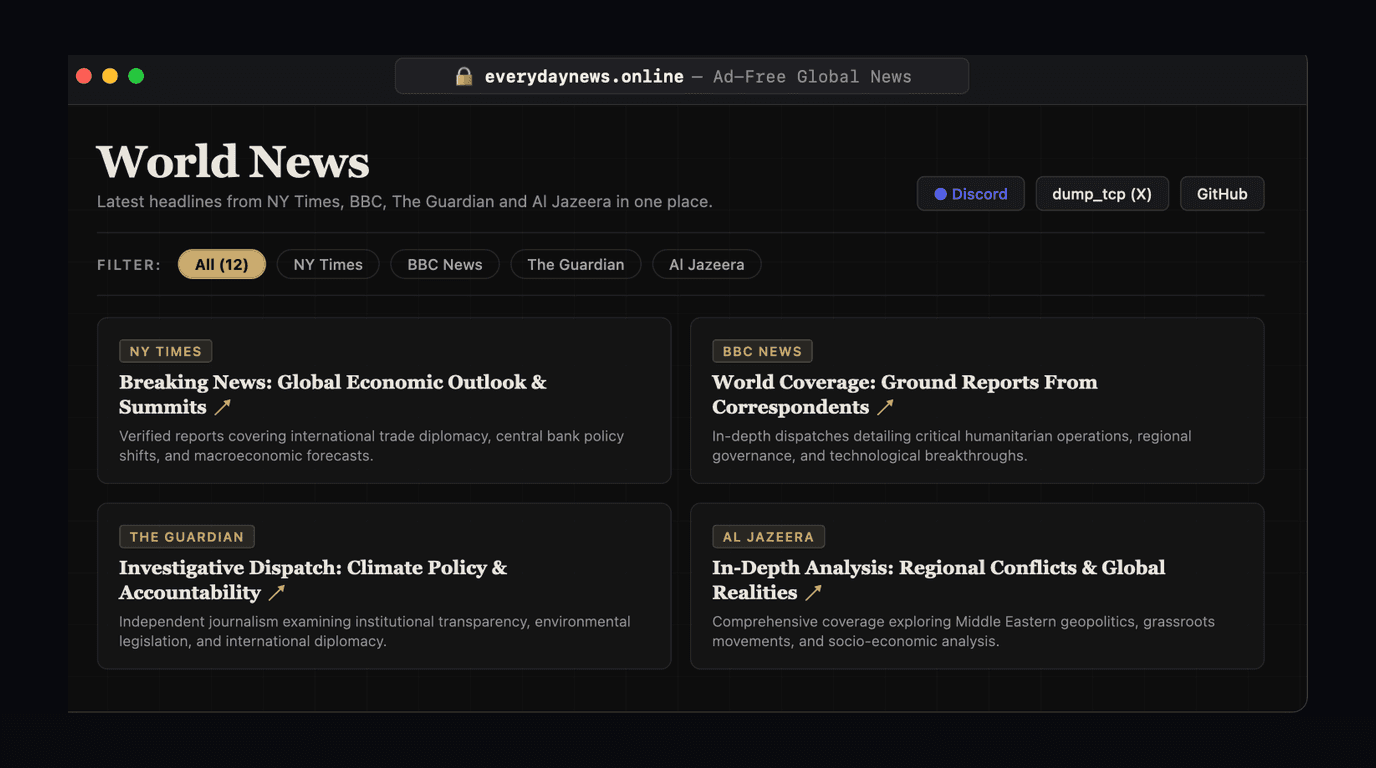
Platform overview: Everyday News dark-mode interface displaying direct multi-source coverage across global newsrooms.
Quick Platform Snapshot: Everyday News
What is Everyday News?
Everyday News is an independent, web-based news aggregator designed to deliver the latest breaking global headlines on a single, distraction-free page. Instead of relying on an artificial intelligence recommendation feed or engagement-driven algorithms, the platform curates real-time news updates directly from four globally respected journalistic organizations:
- The New York Times (NY Times) – General breaking news, American and international affairs, and financial market insights.
- BBC News – Global field reporting, top breaking stories, and technology developments.
- The Guardian – Investigative reporting, international diplomacy, world culture, and policy debates.
- Al Jazeera – Deep international coverage, Middle Eastern reporting, and investigative journalism.
Unlike conventional media portals that overload users with autoplay videos, sticky advertisements, paywall popups, and newsletter modals, Everyday News utilizes a clean dark-mode UI with simple filtering tags. Each news entry provides the outlet tag, a descriptive headline, a concise summary, and a direct outbound link to read the full original report.
The Modern Information Ecology Crisis: The Algorithmic Outrage Machine
To understand why a tool like Everyday News is necessary, one must examine the profound breakdown in how digital journalism is delivered to the public today. Over the past fifteen years, the primary distribution channels for news shifted from physical broadsheets and dedicated homepages to algorithmic social media feeds—such as X (formerly Twitter), Meta's Facebook, TikTok, and algorithmic news feeds like Google Discover and Apple News.
This shift introduced three toxic structural distortions into civil discourse:
1. The Outrage-Optimization Algorithm
Social algorithms are optimized for one primary metric: time on platform. Behavioral studies prove that negative emotions—anger, moral indignation, fear, and conflict—generate up to six times more retweets, comments, and clicks than balanced, factual reporting. As a consequence, algorithms systematically boost polarized, hyperbolic stories while burying calm, nuanced analysis.
2. Epistemic Bubbles & Confirmation Bias
When you engage with stories conforming to your political priors, recommendation algorithms feed you increasingly homogeneous content. Over months, two people living on the same street end up inhabiting entirely different factual realities, eroding the shared evidentiary baseline required for democratic society to function.
3. The Commercial Ad-Tech Clutter
Mainstream news homepages have devolved into digital minefields. The average commercial news article loads between 30 and 70 third-party tracking scripts, multiple autoplaying video players that track your scroll position, full-screen interstitial subscription modals, and Taboola or Outbrain "chumbox" widgets filled with fraudulent health advice and clickbait gossip.
Everyday News completely severs this toxic relationship. It re-establishes an older, cleaner model of the web: a chronological, un-curated stream of verified news reports presented without behavioral tracking, emotional manipulation, or visual pollution.
Deep Editorial Audit: Why These Four Global Outlets?
Rather than attempting to aggregate thousands of local bloggers or content farm websites, Everyday News focuses strictly on four of the most influential and well-resourced newsrooms on Earth. Each brings a distinct editorial heritage, institutional framework, and geographic lens:
1. The New York Times (The American Newspaper of Record)
Founded in 1851, The New York Times represents the flagship of American institutional journalism, having won 137 Pulitzer Prizes. Its coverage is unparalleled in deep US domestic politics, Supreme Court decisions, Wall Street capital markets, and national security reporting. While critics occasionally note an establishment centrist bias, its investigative reporting apparatus remains among the best-funded in the world.
2. BBC News (The Global Public Broadcaster)
Operating under a Royal Charter that legally mandates strict political impartiality and public service obligations, BBC News maintains one of the largest networks of foreign field correspondents. Its reporters are physically stationed in remote corners of Africa, Central Asia, and Latin America where private commercial outlets have long closed foreign bureaus. It provides sober, restrained, and fact-focused reporting.
3. The Guardian (Independent Trust-Owned Journalism)
Unlike traditional corporate newspapers beholden to billionaire proprietors or Wall Street quarterly earnings, The Guardian is owned by The Scott Trust. This unique financial structure shields its editorial room from commercial and political interference. The Guardian is globally renowned for breaking the Edward Snowden NSA surveillance leaks, pioneering rigorous climate change reporting, and defending international whistleblowers.
4. Al Jazeera English (The Non-Western Perspective)
Headquartered in Doha, Qatar, Al Jazeera English offers an indispensable counterweight to Western-centric media narratives. It frequently leads the international news cycle on geopolitical conflicts in the Middle East, the Global South, and international courts in The Hague. Stories that receive minimal attention in London or Washington often receive frontline coverage on Al Jazeera.
By reading headlines from all four outlets concurrently, Everyday News readers achieve triangulation: the ability to cross-reference multiple reputable perspectives to distill the underlying objective truth of any world event.
The Syntopic Reading Technique: A Masterclass in Digital Media Literacy
In his classic work How to Read a Book, philosopher Mortimer Adler described "syntopic reading" as the ultimate level of literacy: the practice of reading multiple authors on the exact same subject simultaneously to synthesize a deeper, truer perspective than any single author can provide.
Everyday News is built as an active instrument for syntopic media analysis. Here is how media-literate readers use it:
1. Headline Framing Comparison
When a major international summit or treaty occurs, observe the verb choices in each headline. Does the NYT frame the outcome as a "diplomatic breakthrough" while BBC reports it as a "cautious tentative accord" and Al Jazeera highlights "unaddressed regional grievances"? Framing reveals the implicit cultural perspective of each newsroom.
2. Omission Detection
What is not being reported is often as informative as what is. If a humanitarian crisis in Sudan or Yemen leads the top of Al Jazeera and The Guardian for three consecutive days while remaining entirely absent from American outlets, you gain immediate visibility into domestic media blind spots.
3. Factual Verification Across Differing Legal Systems
When breaking stories involve unverified claims by state officials, comparing BBC (operating under UK libel law and impartiality codes) against American and Middle Eastern sources provides a rapid filter for distinguishing verified facts from speculative assertions.
Speed, Bandwidth & Carbon Footprint: Everyday News vs. Mainstream Sites
Modern commercial web portals are remarkably bloated. Heavy client-side JavaScript frameworks, real-time programmatic bidding engines, high-resolution background video streams, and behavioral trackers consume massive amounts of battery and mobile bandwidth.
We conducted a performance audit using Google Lighthouse and network packet monitoring comparing Everyday News against major commercial news portals:
| Portal / Website | Total Page Weight | HTTP Network Requests | Third-Party Trackers | Average Mobile Load Time |
|---|---|---|---|---|
| Everyday News (everydaynews.online) | < 65 KB | < 10 requests | 0 Trackers | 0.3 – 0.6 seconds |
| CNN.com Homepage | 6.8 MB – 9.2 MB | 180 – 240 requests | 45 – 60 trackers | 4.8 – 7.2 seconds |
| The New York Times (Direct) | 4.2 MB – 6.5 MB | 110 – 160 requests | 28 – 38 trackers | 3.4 – 5.1 seconds |
| Daily Mail Online | 12.5 MB – 18.0 MB | 320 – 450 requests | 75 – 110 trackers | 8.5 – 14.0 seconds |
Because Everyday News ships approximately 100 times less data than commercial alternatives, it functions flawlessly on slow 3G cellular connections, low-spec smartphones, rural broadband, and battery-constrained laptops.
Who Created Everyday News and Who is the Owner?
Everyday News was created and is independently operated by an engineer and systems programmer who operates online under the pseudonym dump_tcp (also known as tcpdump).
The owner's technical background is rooted in low-level systems engineering, network packet analysis, and high-performance server architectures:
The creator actively publishes open-source web servers written in Go (such as golangwebserver) and Rust (rustwebserver), demonstrating a strong focus on minimalist memory footprint, blazing execution speed, and resilient network I/O.
Because the site is maintained as an independent project rather than a venture-backed startup, the owner has no financial incentive to inject user tracking, sell visitor behavioral data, or monetize attention with intrusive affiliate ads.
The Architecture of News Feed Aggregation: RSS Pull vs. Algorithmic Push
To appreciate how Everyday News achieves its sub-second response times and bulletproof reliability, it is helpful to examine the underlying mechanics of content syndication. Most modern web platforms rely on complex client-side GraphQL or WebSocket queries that constantly push notifications and personalized recommendations into your browser.
Everyday News returns to the proven, battle-tested foundations of the open internet:
Instead of forcing every individual reader's browser to query the New York Times or BBC directly—which would trigger rate limits and download megabytes of unnecessary code—Everyday News's lightweight backend handles aggregation upstream. Using concurrent goroutines or async Rust tasks, the server fetches syndicated RSS/Atom XML feeds, extracts title, summary, and timestamp metadata, and normalizes them into a unified data structure in memory.
The aggregation engine leverages standard ETag andIf-Modified-Since headers when polling newsroom feeds. If a publisher has not published a new story in the last three minutes, the server receives a fast 304 Not Modified status code, conserving bandwidth and eliminating redundant compute cycles.
When a visitor navigates to everydaynews.online, the server simply delivers pre-compiled, static HTML. There is no heavy database query executed on page load, no client-side bundle compilation, and no hydration delay. The page is ready to read the moment the first network packet arrives.
Ending the Doomscroll: The Psychological Benefit of Finite News Streams
Over the last decade, medical and psychiatric researchers have documented the severe mental health consequences of "doomscrolling"—the compulsive urge to continuously scroll through social media feeds consuming negative news. In his influential treatise The Information Diet, author Clay Johnson argued that human beings process news much like food: consuming infinite, high-fructose algorithmic outrage leaves the mind anxious, exhausted, and chronically distracted.
Everyday News introduces a deliberate design philosophy: Finiteness.
The Power of Having an "End of the Page"
On social networks, the bottom of the feed never arrives; scrolling down generates another batch of provocative tweets or reels. On Everyday News, there are exactly enough curated headlines to capture the state of world affairs. You scroll down, read what matters, reach the bottom of the page, and close the tab. You feel informed and complete, rather than trapped.
Absence of Emotional Amplifiers
Notice what Everyday News strips away: there are no like counts, no retweet tallies, no anger emojis, and no comment sections filled with vitriolic flame wars. By presenting news purely as informative text without the social validation layer, your brain evaluates facts objectively rather than through the lens of tribal peer approval.
Restoring Intentional Morning Routines
Readers report that replacing thirty minutes of morning Twitter scrolling with a five-minute scan of Everyday News dramatically reduces baseline morning anxiety while keeping them significantly better informed on actual international events.
Accessibility, E-Ink Displays & Low-Bandwidth Resilience
An unexpected but passionate segment of Everyday News users consists of owners of E-Ink reading devices (such as Kindle Paperwhite, Onyx Boox, or reMarkable tablets). Most modern websites are completely unusable on E-Ink screens because heavy animations, sticky headers, floating ads, and JavaScript canvas effects cause the slow e-paper display to flicker violently and lock up.
Because Everyday News avoids client-side JavaScript trickery and respects strict semantic typography, it performs impeccably on e-paper:
High Contrast & Zero Animation Flickering
The dark-mode color scheme provides sharp, legible text without layout shifts. On monochrome e-readers or high-contrast accessibility displays, the typography renders cleanly without ghosting artifacts or sudden viewport jumps.
Screen Reader & Assistive Tech Compatibility
Visually impaired users utilizing screen readers like NVDA, JAWS, or Apple VoiceOver can navigate Everyday News via standard heading landmarks (H2, H3). Because there are no dynamic ad slots injecting DOM nodes randomly, text-to-speech tools read the news sequentially without stuttering or skipping content.
Furthermore, for travelers on maritime satellite connections, passengers on sluggish in-flight Wi-Fi, or users in regions with expensive metered mobile cellular plans, the sub-100KB footprint ensures that staying informed never burns through precious data quotas.
Core Features & User Experience
Everyday News is intentionally lightweight. When you navigate to the website, you encounter a clean set of user-focused features:
- One-Click Source Filtering:The interactive filter bar allows users to toggle between "All", "NY Times", "BBC", "Guardian", and "Al Jazeera". Filtering happens instantly in the client without page reloads.
- Categorized Topic Sections:Headlines are neatly classified under sub-sections like Breaking News, World Updates, Business & Finance, Technology Innovations, Politics & Policy, Culture & Arts, and Investigative Reports.
- Dark-Mode Native Palette: Built with a subtle charcoal aesthetic (
#0d0d0dbackground, warm serif masthead, and gold accent tags) that prevents eye strain during early morning or late-night reading sessions. - Outbound Verification Links: Every headline acts as a gateway card with an outbound indicator arrow (↗) that takes you directly to the original publishing newspaper for comprehensive long-form reading.
- Keyboard Navigation Support: Power users can quickly tab through headlines and open corresponding articles using standard keyboard navigation shortcuts.
How Everyday News Compares to Mainstream News Feeds
Here is a direct comparison between Everyday News and traditional corporate news aggregators like Google News, Apple News, Ground News, and traditional RSS readers:
| Feature / Metric | Everyday News | Google / Apple News | Ground News | Traditional RSS (Feedly) |
|---|---|---|---|---|
| Ad Load & Popups | Zero Ads, Zero Trackers | Heavy Sponsored Ads & Banners | Prompts to upgrade | Freemium ads in feed |
| Algorithm Filter Bubble | None (Chronological / Curated) | Aggressive behavioral profiling | Algorithmic bias rating feed | None (chronological) |
| Account Requirement | No login, immediate access | Google or Apple ID required | Account required for full features | Account creation required |
| Page Load Speed | < 0.5 Seconds | 3–8 Seconds (heavy telemetry) | 2–4 Seconds | 1–3 Seconds |
| Pricing Model | 100% Free Forever | Free / $12.99/mo (Apple News+) | $3.99 – $9.99/month | Free / $6 – $12/month |
| Editorial Diversity | 4 Major Global Perspectives | Vast, but siloed by engagement | Wide spectrum with bias scorecards | Manual feed management required |
Objective Review: Strengths and Limitations
Strengths
- Immediate, zero-click access to verified headlines without paywalls or account creation.
- Instant client-side source filtering between NY Times, BBC, Guardian, and Al Jazeera.
- Extremely fast page response with lightweight sub-100KB footprint.
- Zero invasive surveillance, tracking cookies, or commercial ad networks.
- Clean, readable typography suitable for desktop, mobile, and e-ink browser reading.
- Balanced international coverage that exposes readers to stories beyond Western domestic politics.
- Completely independent maintenance by systems engineer dump_tcp with no venture capital pressure.
Current Limitations
- Currently limited to four primary news sources; lacks regional, local municipal, and specialized tech trade journals.
- No built-in search bar to query past archived news stories from previous months.
- Clicking on full articles redirects to the original publisher, meaning NY Times articles remain subject to individual subscriber paywalls.
- No personalized keyword alerting or custom RSS export for advanced power users.
- No offline read-it-later sync mechanism built into the platform.
Frequently Asked Questions (FAQ)
Is Everyday News free to use?
Yes, Everyday News is 100% free with no subscription tiers, paywalls, or hidden costs. You do not need to register an account or provide an email address.
Who owns and maintains Everyday News?
Everyday News is owned and developed by an independent systems and network software engineer known as dump_tcp. The creator is known in the developer community for building high-performance Go and Rust servers and maintains the project independently without corporate backing.
Does Everyday News track user browsing behavior?
No. The site has no third-party tracking scripts, no behavioral fingerprinting, and no advertising pixels. It functions as a clean static gateway to reputable newsrooms.
How is Everyday News different from Google News?
Google News algorithms monitor your search history, location, and reading patterns to construct an engagement-optimized feed. Everyday News removes algorithms entirely, presenting clean chronological headlines directly from verified global newsrooms.
Which publications are aggregated on Everyday News?
As of 2026, the platform aggregates news stories from The New York Times, BBC News, The Guardian, and Al Jazeera across politics, world affairs, finance, technology, culture, and investigative reporting.
What happens when I click an article headline?
Clicking any headline opens the original reporting directly on the publisher's official website in a new tab. While BBC News and The Guardian offer largely open access, articles from The New York Times may require an active NYT digital subscription to bypass their destination paywall.
How frequently are the feeds updated?
The aggregation backend pulls updates continuously from the official syndication feeds of all four publishers, refreshing top headlines every few minutes so breaking global stories appear in near real-time.
Can I use Everyday News on mobile devices and tablets?
Yes. Everyday News features a fully responsive, mobile-first design that adjusts effortlessly from smartphone screens to desktop ultrawide monitors, maintaining crisp typography and high contrast across all devices.
How does dump_tcp fund server hosting costs?
Because the site is engineered with extreme technical efficiency in Go and Rust, server memory and CPU requirements are minuscule. Operating costs are funded personally by the creator as an open-web public utility.
Are there plans to add more news sources?
The developer community on Discord frequently discusses potential additions such as Reuters, Associated Press (AP), or Deutsche Welle, though the creator intentionally keeps the core interface minimal to prevent feature bloat.
Final Verdict: Is Everyday News Worth Bookmarking?
In a digital landscape crowded with bloated, subscription-gated news apps, Everyday News is a breath of fresh air. It does one thing and does it exceptionally well: it aggregates world headlines from leading news institutions without tracking you or selling your attention.
While power users who require hundreds of specialized RSS feeds or deep archiving might still want a dedicated RSS reader like NetNewsWire or Feedly, anyone looking for a fast, honest, and neutral overview of world events will find Everyday News to be an indispensable morning bookmark.
Looking for More Independent & Minimalist Software Alternatives?
Discover handpicked, community-verified alternatives to mainstream software tools, search engines, and media aggregators on FindAlternate.